



How infrastructure secondaries can be additive to an investor‘s portfolio

2025 marked a record year for the infrastructure secondaries market, with deal volumes reaching approximately $25 billion1. Looking ahead, the infrastructure secondaries market is expected to be among the fastest-growing segments within private markets, offering investors an expanding and increasingly diverse investment opportunity set.

Since 2016, infrastructure assets under management have expanded at a compound annual growth rate of approximately 17%, surpassing most other major private capital asset classes. This sustained growth has been driven by megatrends, including decarbonization, digitization, urbanization, sustainability, and demographic trends, cementing infrastructure as a core allocation within institutional portfolios.

Looking ahead, the outlook for infrastructure secondaries is increasingly compelling. The sheer scale of primary private infrastructure fundraising over the past decade, combined with the growing maturity of these funds and the continued expansion of the infrastructure manager universe, is set to translate into a steadily rising volume of secondary opportunities in the near to medium term. This dynamic has been further reinforced by the heightened need for both LPs and GPs to generate liquidity following several years of subdued M&A activity. 

LPs turn to the secondary market for a wide range of reasons. These include the need to raise liquidity at the portfolio level, including, at times, distressed or “fire-sale” transactions, as well as portfolio rebalancing driven by the denominator effect, over-exposure to specific managers or strategies, or broader shifts in investment strategy. Against this backdrop, infrastructure secondaries remain one of the fastest-growing, and still relatively undercapitalized, segments of the global secondaries market. As per PJT, the infrastructure secondaries market has grown from c. $11 billion to c. $25 billion over the last two years. Going forward, the market is expected to reach c. $45 billion by the end of the decade. 1

Infrastructure funds AuM (USDbn)1
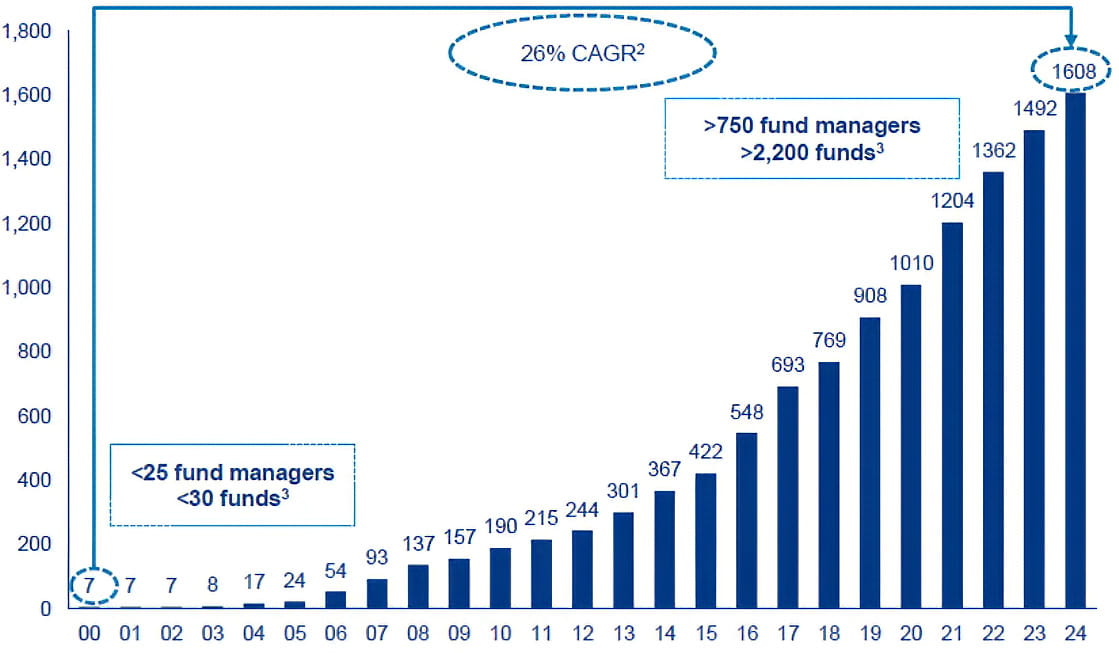
Infrastructure funds AuM (USDbn)

1As of September 2024. 2Compound annual growth rate, i.e. the annualized average rate of growth. 3All active unlisted infrastructure funds excluding de-listed and mutual funds; including infrastructure funds investing in debt-like instruments. Last available data as of June 2025. Source: Allianz Global Investors, based on Preqin data accessed in June 2025.

Infrastructure Secondaries
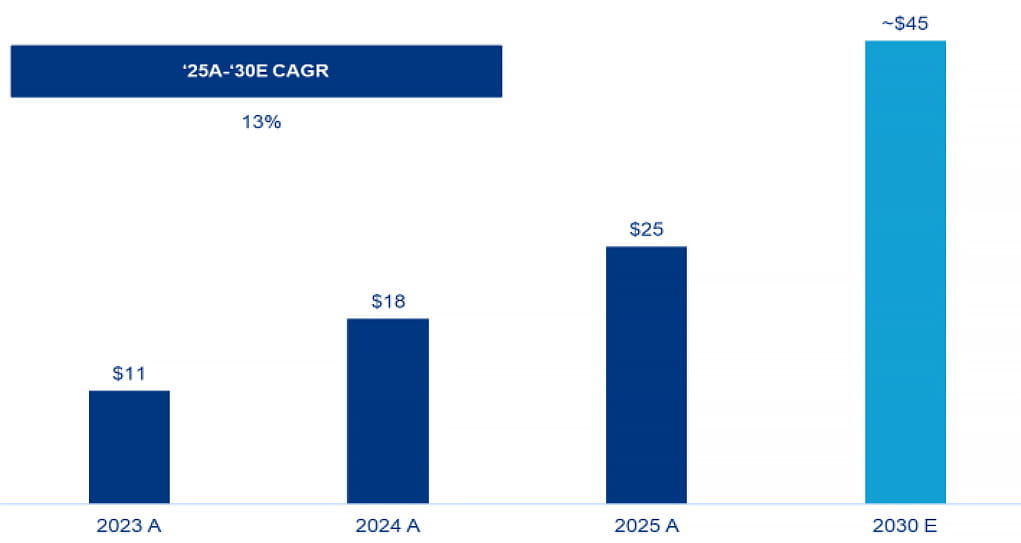

Source: PJT Partners, FY2025 Secondary Market Insight (January 2026); PJT PCS Market Intelligence, responses to the FY 2025 PJT Park Hill Secondaries Market Survey. (1) Historical volume estimates based on previous PJT PCS Market Insight reports.

We believe that infrastructure secondaries offer a compelling investment proposition, combining the defensive and cash-generative characteristics of the infrastructure asset class with the distinctive advantages of the secondary transaction dynamic.

Firstly, secondary transactions typically provide exposure to more mature funds that are already well advanced in their value-creation or harvesting phase. At this stage of the lifecycle, assets are often inherently less risky (for example, projects that were previously in development may now be fully constructed and operational), resulting in a more de-risked investment profile.

Secondly, secondary investments can meaningfully mitigate the J-curve commonly associated with primary commitments. By acquiring interests in seasoned portfolios that a general partner has already held for several years, investors gain exposure to assets with shorter remaining hold periods and, consequently, more visible exit timelines. In infrastructure specifically, these assets are also more likely to be cash-yielding from day one, enhancing early cash flow and return predictability for secondary buyers.

Thirdly, secondaries provide a rare opportunity to access high-quality assets that are not otherwise available for sale. Through secondary transactions, investors can gain exposure to infrastructure assets that GPs have accumulated over many years and are not actively looking to divest. This feature is particularly attractive in private infrastructure, where certain sub-segments may be characterized by a limited number of highly attractive assets benefiting from strong competitive advantages. 

Taken together, these characteristics underscore the role of infrastructure secondaries as a valuable complement within institutional portfolios. As investors increasingly seek portfolio visibility, earlier cash flows, and access to high-quality assets, infrastructure secondaries are well positioned to represent a growing share of private market allocations in the years ahead.

1 Preqin, PJT Partners – FY2025 Secondary Market Insight (January 2026) 

Investing involves risk. The value of an investment and the income from it will fluctuate and investors may not get back the principal invested. Past performance is not indicative of future performance. This is a marketing communication. It is for informational purposes only. This document does not constitute investment advice or a recommendation to buy, sell or hold any security and shall not be deemed an offer to sell or a solicitation of an offer to buy any security.

The views and opinions expressed herein, which are subject to change without notice, are those of the issuer or its affiliated companies at the time of publication. Certain data used are derived from various sources believed to be reliable, but the accuracy or completeness of the data is not guaranteed and no liability is assumed for any direct or consequential losses arising from their use. The duplication, publication, extraction or transmission of the contents, irrespective of the form, is not permitted. This material has not been reviewed by any regulatory authorities. In mainland China, it is for Qualified Domestic Institutional Investors scheme pursuant to applicable rules and regulations and is for information purpose only. This document does not constitute a public offer by virtue of Act Number 26.831 of the Argentine Republic and General Resolution No. 622/2013 of the NSC. This communication's sole purpose is to inform and does not under any circumstance constitute promotion or publicity of Allianz Global Investors products and/or services in Colombia or to Colombian residents pursuant to part 4 of Decree 2555 of 2010. laws.

This communication does not in any way aim to directly or indirectly initiate the purchase of a product or the provision of a service offered by Allianz Global Investors. Via reception of this document, each resident in Colombia acknowledges and accepts to have contacted Allianz Global Investors via their own initiative and that the communication under no circumstances does not arise from any promotional or marketing activities carried out by Allianz Global Investors. Colombian residents accept that accessing any type of social network page of Allianz Global Investors is done under their own responsibility and initiative and are aware that they may access specific information on the products and services of Allianz Global Investors. This communication is strictly private and confidential and may not be reproduced, except for the case of explicit permission by Allianz Global Investors. This communication does not constitute a public offer of securities in Colombia pursuant to the public offer regulation set forth in Decree 2555 of 2010. This communication and the information provided herein should not be considered a solicitation or an offer by Allianz Global Investors or its affiliates to provide any financial products in Brazil, Panama, Peru, and Uruguay. In Australia, this material is presented by Allianz Global Investors Asia Pacific Limited (“AllianzGI AP”) and is intended for the use of investment consultants and other institutional /professional investors only, and is not directed to the public or individual retail investors. AllianzGI AP is not licensed to provide financial services to retail clients in Australia. AllianzGI AP is exempt from the requirement to hold an Australian Foreign Financial Service License under the Corporations Act 2001 (Cth) pursuant to ASIC Class Order (CO 03/1103) with respect to the provision of financial services to wholesale clients only. AllianzGI AP is licensed and regulated by Hong Kong Securities and Futures Commission under Hong Kong laws, which differ from Australian

This document is being distributed by the following Allianz Global Investors companies: Allianz Global Investors GmbH, an investment company in Germany, authorized by the German Bundesanstalt für Finanzdienstleistungsaufsicht (BaFin); Allianz Global Investors (Schweiz) AG; Allianz Global Investors UK Limited, authorized and regulated by the Financial Conduct Authority; in HK, by Allianz Global Investors Asia Pacific Ltd., licensed by the Hong Kong Securities and Futures Commission; in Singapore, by Allianz Global Investors Singapore Ltd., regulated by the Monetary Authority of Singapore [Company Registration No. 199907169Z]; in Japan, by Allianz Global Investors Japan Co., Ltd., registered in Japan as a Financial Instruments Business Operator [Registered No. The Director of Kanto Local Finance Bureau (Financial Instruments Business Operator), No. 424], Member of Japan Investment Advisers Association, the Investment Trust Association, Japan and Type II Financial Instruments Firms Association; in Taiwan, by Allianz Global Investors Taiwan Ltd., licensed by Financial Supervisory Commission in Taiwan; and in Indonesia, by PT. Allianz Global Investors Asset Management Indonesia licensed by Indonesia Financial Services Authority (OJK).
Source picture: ©alphaspirit - stock.adobe.com

Admaster 5319255

Allianz Global Investors

U verlaat de pagina van Allianz Global Investors en gaat naar