
banks-safe-and-sound


What has happened?

Banks have felt the brunt of market volatility in recent weeks. Since the collapse of Silicon Valley Bank (SVB) in the US, several other banks have struggled. The most high-profile victim is arguably Credit Suisse, which was taken over by rival UBS in a state-brokered rescue.

While the intervention of central banks and regulators in the above cases was intended to calm market nervousness, the subsequent and as-yet-unexplained pressure on the stock price of Deutsche Bank (DB) suggests that some were looking to test confidence. Regulators are investigating whether a single trade on Deutsche Bank’s credit-default swaps – a form of insurance against potential default – triggered the market action.1

While each bank under the spotlight has specific characteristics, these incidents are also the consequences of a sharp rise in interest rates after years of easy monetary policy. As in the past, financial stresses can occur as the global economy rebalances.

Piecing the recent events together, is there any reason to be concerned about the health of the broader European banking sector? Our specialists offer their analysis.

Our Views

Dirk Becker

Dirk Becker

Senior Portfolio Manager, Global Financials

“European banks are likely to have sufficient liquidity to withstand stress”

We have seen no evidence of a crisis in European banks in the days since the DB market fluctuations on 24 March. In what we view as a signal that European banks are solid and sound, the European Central Bank (ECB) on 28 March approved a EUR 3.4 billion share buyback application from Italian lender UniCredit.2

We believe the ECB has good reasons for this confidence. After the 2008 global financial crisis, international regulators introduced rules forcing banks to be conservative in their funding and liquidity management. Take two of the key financing ratios that can be used to assess the resilience of banks:

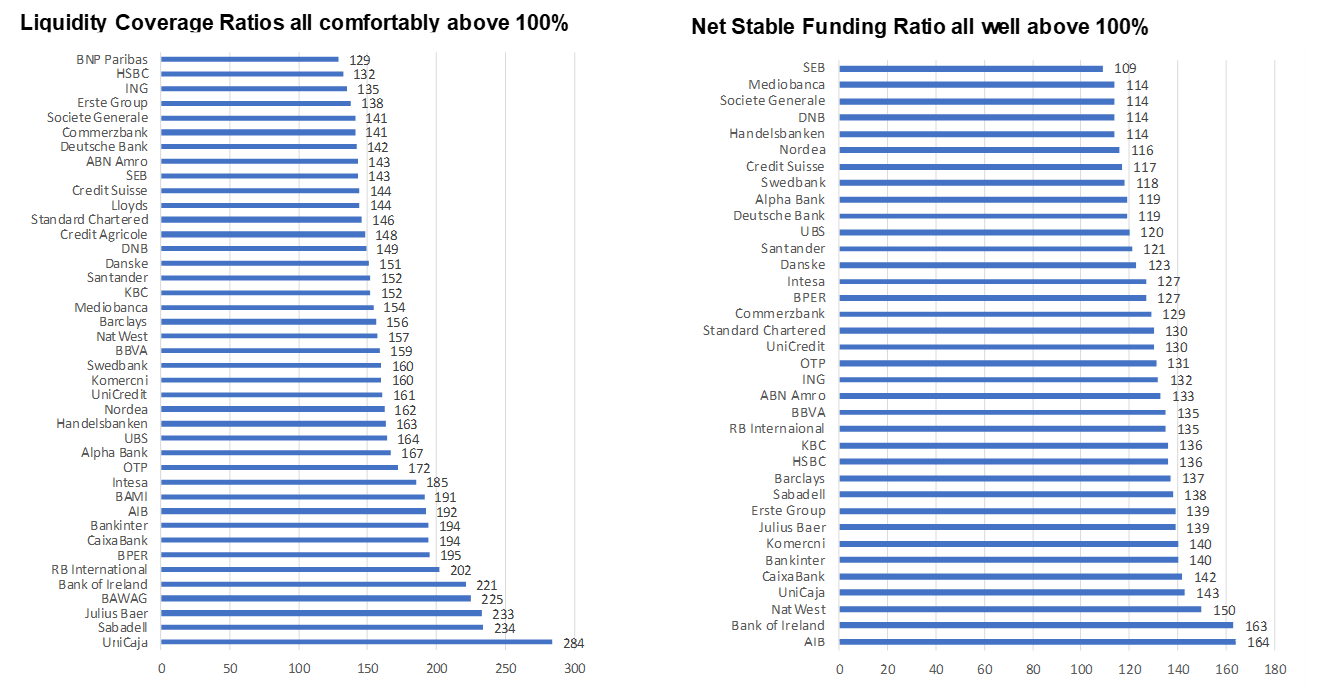
Liquidity coverage ratio (LCR): this measures the short-term resilience of a bank’s liquidity profile by assessing whether sufficient high-quality liquid assets – such as central bank deposits or short-term government bonds – are available to meet expected net cash outflows in a stress scenario, like a crisis. The median LCR of the large European banks is around 150% (see Exhibit 1). In our view, that ratio provides enough available liquidity even after a stress event. In comparison, the median LCR ratio for the large US banks is around 120%.

Net stable funding ratio (NSFR): this isintended to limit overreliance on short-term wholesale funding. It measures two areas:

  • Available stable funding – in other words, capital and liabilities expected to be available over the period of one year.
  • Required stable funding – calculated from its assets based on their maturity and encumbrance (eg, whether they as been pledged as collateral), potential for contingent calls on the funding, and liquidity from off-balance sheet exposures.

Typically, European banks also comply well with the NSFR, with the median bank having a ratio of around 130%, which means they have excess stable funding (see Exhibit 1).

Exhibit 1: liquidity coverage and net stable funding ratios for European banks

Exhibit 1: European banks net profit (EUR billion)

Sources: 1 AllianzgGI/UBS Research, 21 March 2022. Most recent disclosure. Past performance does not predict future returns. Forecasts do not predict future returns.


In the US, different rules apply

These ratios are costly for banks as they require them to hold large amounts of idle liquidity – which in times of negative rates can be particularly onerous – and build expensive retail deposit franchises.

Therefore, the US government decided in 2018 to lift the burden for its regional banks with assets below USD 250 billion in a bid to grow the economy.3 Among other regulatory reliefs, US regulators allowed them to ignore LCR and NSFR. This lifted regional banks’ returns and helped them to grow their loan book – providing a positive short-term boost for the economy. But it also increased risks.

Under ECB regulation, SVB would not be allowed to adopt the balance sheet approach that got it into trouble.

But it’s not just funding ratios that are stricter. European banks have also built up their capital ratios over recent years. Together with the tight regulation on liquidity and funding, their capital ratios have become much more stable and resilient.

Simon Outin

Simon Outin

Director of Financials Research, Global

“Monetary policy dilemma at the heart of the recent banking stress”

Questions about the liquidity of the banking sector have loomed large for many investors in recent weeks.

Efforts by central banks to control inflation by raising interest rates can have implications for financial system stability. We believe this monetary policy dilemma is the root cause of the recent stress in the banking sector. In our view, this challenge is here to stay – and we are seeking to adjust our portfolios based on this new reality where liquidity and funding are the most important consideration for markets over the next few months.

With this in mind, we have taken a closer look at the liquidity regulatory disclosures provided by a sample of 50 European and US banks in their Pillar 3 reports. These are mandatory regulatory disclosures banks must make about their levels of capital, liquidity and risk exposure as part of Basel III banking rules.

Our findings: the proportion of stable retail deposits is an excellent indication of credit strength in the current volatile environment

We compared the breakdown of the deposit base across four categories – from the most stable retail deposits (those that are, among other factors, fully insured by an effective deposit insurance scheme or by a public guarantee) to wholesale non-operational deposits, modelled by regulators as the most volatile type of deposits. The categories are defined under the Basel Framework measure of Liquidity Coverage Ratio4 – the proportion of highly liquid assets held by financial institutions to ensure they can meet short-term obligations.

We found significant differences by comparing the deposit base of banks by country (see Exhibit 2). For example, banks in Spain, Ireland, and Italy hold a much higher proportion of stable retail deposits than their counterparts in Switzerland, the UK, or the US. In our opinion, a high share of stable retail deposits is an excellent indication of credit strength in the current volatile environment for two main reasons:

  • These banks are potentially more resilient in a confidence crisis scenario as the key funding source is coming from fully insured transactional deposits with a well-established stability track record.
  • They rely more heavily on traditional banking business models and are less exposed to corporate and investment banking activities that are potentially more at risk from changes in market sentiment.
Exhibit 2: breakdown of the average deposit base of banks by country
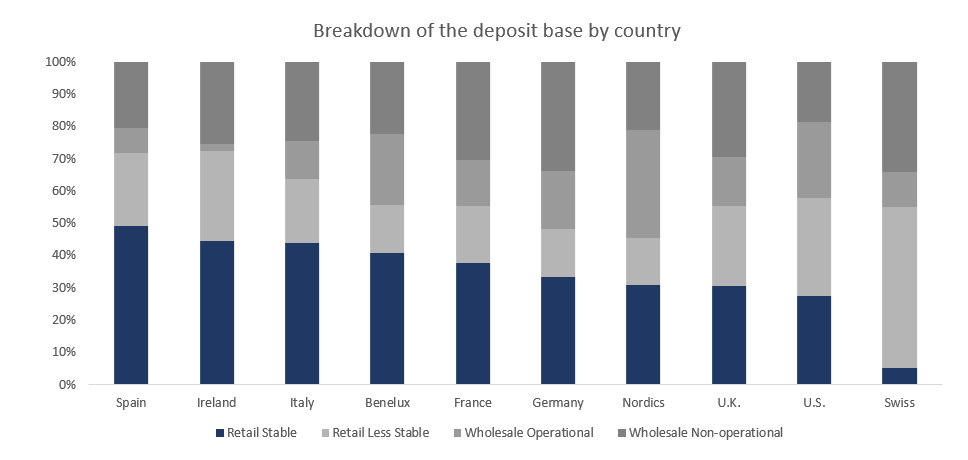
Exhibit 2: breakdown of the average deposit base of banks by country

Source: Allianz Global Investors research based on Pillar 3 reports for a sample of 50 banks. Data as at 31 December 2022

The contrast between deposit bases is even higher when comparing bank by bank (see Exhibit 3). For example, small-sized Spanish and UK banks have a much higher proportion of stable retail deposits. In contrast, large-sized US and Swiss banks hold a bigger proportion of wholesale, non-operational deposits.

Naturally, we consider other factors in our investment decision making. Generally, we believe the most systemic banks – those considered “too big to fail” in a crisis – are likely to emerge stronger because of a flight to quality.

Exhibit 3: breakdown of the average deposit base by bank size
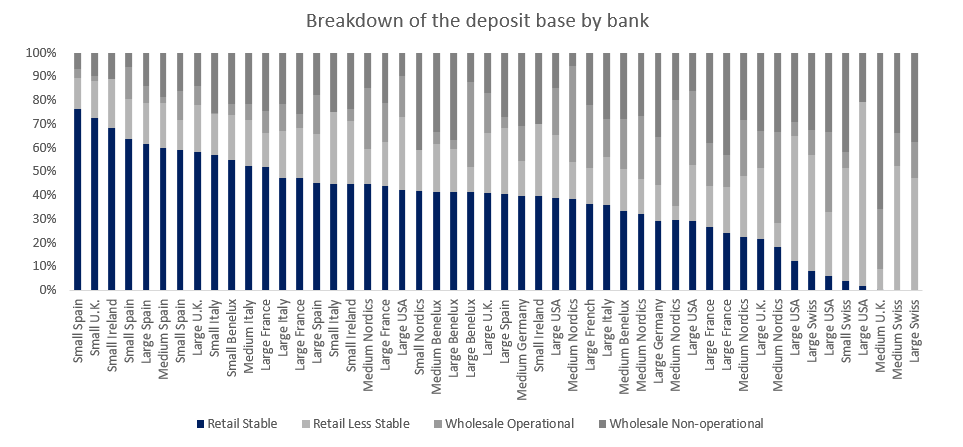
Exhibit 3: breakdown of the average deposit base by bank size

Source: Allianz Global Investors research based on Pillar 3 reports for a sample of 50 banks. Data as at 31 December 2022

Welcome to Allianz Global Investors

  • Individual Investor
  • Institutional Advisor